Selasa, 31 Desember 2013

[I193.Ebook] Ebook Evolutionary Psychology: An Introduction, by Lance Workman, Will Reader

Ebook Evolutionary Psychology: An Introduction, by Lance Workman, Will Reader

For everybody, if you wish to start accompanying others to read a book, this Evolutionary Psychology: An Introduction, By Lance Workman, Will Reader is much advised. And you need to obtain guide Evolutionary Psychology: An Introduction, By Lance Workman, Will Reader below, in the link download that we offer. Why should be here? If you want other type of books, you will always locate them as well as Evolutionary Psychology: An Introduction, By Lance Workman, Will Reader Economics, politics, social, scientific researches, faiths, Fictions, and much more publications are supplied. These offered books are in the soft data.

Evolutionary Psychology: An Introduction, by Lance Workman, Will Reader

Evolutionary Psychology: An Introduction, by Lance Workman, Will Reader


Evolutionary Psychology: An Introduction, by Lance Workman, Will Reader

Ebook Evolutionary Psychology: An Introduction, by Lance Workman, Will Reader

Evolutionary Psychology: An Introduction, By Lance Workman, Will Reader When writing can alter your life, when composing can enhance you by supplying much cash, why do not you try it? Are you still quite confused of where understanding? Do you still have no idea with what you are visiting compose? Currently, you will certainly require reading Evolutionary Psychology: An Introduction, By Lance Workman, Will Reader An excellent author is a great visitor simultaneously. You could define exactly how you compose depending on what publications to check out. This Evolutionary Psychology: An Introduction, By Lance Workman, Will Reader could help you to fix the problem. It can be among the best resources to establish your writing skill.

Sometimes, reading Evolutionary Psychology: An Introduction, By Lance Workman, Will Reader is very dull and also it will certainly take long time beginning with getting guide as well as start reviewing. However, in contemporary period, you could take the developing technology by using the net. By web, you can visit this page and start to hunt for the book Evolutionary Psychology: An Introduction, By Lance Workman, Will Reader that is needed. Wondering this Evolutionary Psychology: An Introduction, By Lance Workman, Will Reader is the one that you need, you could go for downloading and install. Have you recognized how you can get it?

After downloading and install the soft file of this Evolutionary Psychology: An Introduction, By Lance Workman, Will Reader, you can begin to review it. Yeah, this is so pleasurable while somebody must read by taking their big publications; you are in your new way by only handle your device. Or perhaps you are working in the office; you could still use the computer to review Evolutionary Psychology: An Introduction, By Lance Workman, Will Reader completely. Of course, it will certainly not obligate you to take several web pages. Just web page by page depending on the moment that you need to check out Evolutionary Psychology: An Introduction, By Lance Workman, Will Reader

After knowing this very easy method to read and get this Evolutionary Psychology: An Introduction, By Lance Workman, Will Reader, why do not you inform to others regarding through this? You could inform others to visit this site and also opt for looking them preferred publications Evolutionary Psychology: An Introduction, By Lance Workman, Will Reader As understood, right here are bunches of listings that supply many kinds of publications to accumulate. Simply prepare few time and net links to obtain the books. You can actually take pleasure in the life by reviewing Evolutionary Psychology: An Introduction, By Lance Workman, Will Reader in a very simple way.

Evolutionary Psychology: An Introduction, by Lance Workman, Will Reader

Written for undergraduate psychology students, and assuming little knowledge of evolutionary science, the third edition of this classic textbook provides an essential introduction to evolutionary psychology. Fully updated with the latest research and new learning features, it provides a thought-provoking overview of evolution and illuminates the evolutionary foundation of many of the broader topics taught in psychology departments. The text retains its balanced and critical evaluation of hypotheses and full coverage of the fundamental topics required for undergraduates. This new edition includes more material on the social and reproductive behaviour of non-human primates, morality, cognition, development and culture as well as new photos, illustrations, text boxes and thought questions to support student learning. Some 280 online multiple choice questions complete the student questioning package. This new material complements the classic features of this text, which include suggestions for further reading, chapter summaries, a glossary, and two-colour figures throughout.

  • Sales Rank: #368170 in Books
  • Published on: 2014-02-24
  • Original language: English
  • Number of items: 1
  • Dimensions: 9.69" h x .94" w x 7.44" l, 2.65 pounds
  • Binding: Paperback
  • 561 pages

Review
"Workman and Reader is a refreshing book in the growing stack of textbooks in evolutionary psychology. Especially from a theoretical perspective it stands out, because it does not present the field as the closed theoretical system one finds in most classic textbooks on the topic. Rather it presents evolutionary psychology as a multifaceted approach to human behavior; surveying known empirical research and accepted theories while critically speculating about unknown territory. Consequently, the book covers more territory than usually is the case, venturing into parts of developmental, cognitive and social psychology that most other textbooks evade. Together with its accessible style and presentation, this makes Workman and Reader almost an introduction in psychology from an evolutionary perspective, rather than just an introduction in evolutionary psychology; and that is an admirable feat."
Jannes Eshuis, Open University of the Netherlands

"In this third edition to Evolutionary Psychology, Lance Workman and Will Reader clearly explain the essential links among evolutionary principles and behavior. We are indebted to the authors for a thoughtful presentation of this developing area of study and for a unique historical and comparative approach. Students and professionals will benefit."
Del Thiessen, Professor Emeritus, University of Texas, Austin

About the Author
Lance Workman is Honorary Visiting Professor of Psychology at the University of Glamorgan.

Will Reader is a Senior Lecturer in Psychology at Sheffield Hallam University.

Most helpful customer reviews

5 of 6 people found the following review helpful.
Five Stars
By hanktheastronaut
Great intro into the material. Very easy to read and gives a balanced view of new and old theories.

0 of 0 people found the following review helpful.
Excellent, balanced introduction
By GGreene
I've read several college-level introductions to this topic, and many academic papers in economics and game theory drawing on ideas of an evolved "human nature" common across cultures: this is the best overview.

0 of 5 people found the following review helpful.
i told you already i was happy with this book for my study
By Ien B.
i told you already i was happy with this book for my study, you asked me the second time so I say again it s o.k.

See all 3 customer reviews...

Evolutionary Psychology: An Introduction, by Lance Workman, Will Reader PDF
Evolutionary Psychology: An Introduction, by Lance Workman, Will Reader EPub
Evolutionary Psychology: An Introduction, by Lance Workman, Will Reader Doc
Evolutionary Psychology: An Introduction, by Lance Workman, Will Reader iBooks
Evolutionary Psychology: An Introduction, by Lance Workman, Will Reader rtf
Evolutionary Psychology: An Introduction, by Lance Workman, Will Reader Mobipocket
Evolutionary Psychology: An Introduction, by Lance Workman, Will Reader Kindle

Evolutionary Psychology: An Introduction, by Lance Workman, Will Reader PDF

Evolutionary Psychology: An Introduction, by Lance Workman, Will Reader PDF

Evolutionary Psychology: An Introduction, by Lance Workman, Will Reader PDF

Kamis, 26 Desember 2013

[H481.Ebook] Get Free Ebook The Four Loves, by C. S. Lewis

Get Free Ebook The Four Loves, by C. S. Lewis

When getting this e-book The Four Loves, By C. S. Lewis as referral to review, you could obtain not only motivation yet likewise new knowledge and also sessions. It has more compared to common perks to take. What sort of e-book that you read it will work for you? So, why should get this publication qualified The Four Loves, By C. S. Lewis in this article? As in link download, you could obtain the e-book The Four Loves, By C. S. Lewis by on the internet.

The Four Loves, by C. S. Lewis

The Four Loves, by C. S. Lewis


The Four Loves, by C. S. Lewis

Get Free Ebook The Four Loves, by C. S. Lewis

The Four Loves, By C. S. Lewis. Reading makes you a lot better. Which claims? Many smart words say that by reading, your life will be better. Do you believe it? Yeah, prove it. If you need the book The Four Loves, By C. S. Lewis to review to show the wise words, you could see this web page perfectly. This is the site that will offer all guides that probably you need. Are guide's collections that will make you really feel interested to review? Among them right here is the The Four Loves, By C. S. Lewis that we will certainly recommend.

If you get the printed book The Four Loves, By C. S. Lewis in on-line book store, you could likewise locate the exact same trouble. So, you should move store to shop The Four Loves, By C. S. Lewis and also hunt for the offered there. Yet, it will certainly not occur here. Guide The Four Loves, By C. S. Lewis that we will supply right here is the soft documents idea. This is just what make you can easily locate as well as get this The Four Loves, By C. S. Lewis by reading this site. Our company offer you The Four Loves, By C. S. Lewis the best product, consistently and constantly.

Never ever question with our offer, because we will certainly always give exactly what you require. As like this updated book The Four Loves, By C. S. Lewis, you could not find in the other place. Yet right here, it's quite easy. Just click and download, you can have the The Four Loves, By C. S. Lewis When convenience will ease your life, why should take the complicated one? You could buy the soft file of the book The Four Loves, By C. S. Lewis here and also be member people. Besides this book The Four Loves, By C. S. Lewis, you could also find hundreds lists of the books from several sources, compilations, authors, as well as authors in around the world.

By clicking the link that we offer, you can take guide The Four Loves, By C. S. Lewis completely. Link to net, download, and save to your tool. Exactly what else to ask? Reading can be so very easy when you have the soft data of this The Four Loves, By C. S. Lewis in your gadget. You could also copy the file The Four Loves, By C. S. Lewis to your workplace computer system or at home as well as in your laptop computer. Merely discuss this excellent news to others. Suggest them to visit this web page and also obtain their searched for publications The Four Loves, By C. S. Lewis.

The Four Loves, by C. S. Lewis

"We need others physically, emotionally, intellectually; we need them if we are to know anything, even ourselves."

We hear often that love is patient and kind, not envious or prideful. We hear that human love is a reflection of divine love. We hear that God is love. But how do we understand its work in our lives, its perils and rewards? Here, the incomparable C. S. Lewis examines human love in four forms: affection, the most basic, general, and emotive; friendship, the most rare, least jealous, and, in being freely chosen, perhaps the most profound; Eros, passionate love that can run counter to happiness and poses real danger; charity, the greatest, most spiritual, and least selfish. Proper love is a risk, but to bar oneself from it--to deny love--is a damning choice. Love is a need and a gift; love brings joy and laughter. We must seek to be awakened and so to find an Appreciative love through which "all things are possible."

"The Four Loves deserves to become a minor classic as a modern mirror of our souls, a mirror of the virtues and failings of human loving." —New York Times Book Review

"Lewis has a keen eye, a large measure of human sympathy, wit, and a command of simple words." —Times Literary Supplement

C. S. (Clive Staples) Lewis (1898-1963), one of the great writers of the twentieth century, also continues to be one of our most influential Christian thinkers. He wrote more than thirty books, both popular and scholarly, including The Chronicles of Narnia series, The Screwtape Letters, The Four Loves, Mere Christianity, and Surprised by Joy.

  • Sales Rank: #4592 in Books
  • Color: Multicolor
  • Brand: Houghton Mifflin Harcourt
  • Published on: 1971-09-29
  • Released on: 1971-09-29
  • Original language: English
  • Number of items: 1
  • Dimensions: 8.00" h x .42" w x 5.31" l, .42 pounds
  • Binding: Paperback
  • 156 pages

Amazon.com Review
The Four Loves summarizes four kinds of human love--affection, friendship, erotic love, and the love of God. Masterful without being magisterial, this book's wise, gentle, candid reflections on the virtues and dangers of love draw on sources from Jane Austen to St. Augustine. The chapter on charity (love of God) may be the best thing Lewis ever wrote about Christianity. Consider his reflection on Augustine's teaching that one must love only God, because only God is eternal, and all earthly love will someday pass away: Who could conceivably begin to love God on such a prudential ground--because the security (so to speak) is better? Who could even include it among the grounds for loving? Would you choose a wife or a Friend--if it comes to that, would you choose a dog--in this spirit? One must be outside the world of love, of all loves, before one thus calculates. His description of Christianity here is no less forceful and opinionated than in Mere Christianity or The Problem of Pain, but it is far less anxious about its reader's response--and therefore more persuasive than any of his apologetics. When he begins to describe the nature of faith, Lewis writes: "Take it as one man's reverie, almost one man's myth. If anything in it is useful to you, use it; if anything is not, never give it a second thought." --Michael Joseph Gross

Review
"A rare and memorable book." —Saturday Review

"The Four Loves deserves to become a minor classic as a modern mirror of our souls, a mirror of the virtues and failings of human loving." —New York Times Book Review

"[Lewis] has never written better. Nearly every page scintillates with observations which are illuminating, provocative and original." —Church Times

"What is interesting about these chapters is the extent to which a non-believer can follow the argument and receive enlightenment … Lewis has a keen eye, a large measure of human sympathy, wit, and a command of simple words … By writing so well and so perceptively about ‘natural’ human conduct, Lewis makes the strongest case for examining his conclusions with respect. He is writing, presumably, for the unconverted as well as for Christians, and whatever the former may believe or disbelieve about God they are persuaded that he could only exist as a culmination in absolute terms of their deepest moral convictions."—Times Literary Supplement

From the Back Cover

"We need others physically, emotionally, intellectually; we need them if we are to know anything, even ourselves."

We hear often that love is patient and kind, not envious or prideful. We hear that human love is a reflection of divine love. We hear that God is love. But how do we understand its work in our lives, its perils and rewards? Here, the incomparable C. S. Lewis examines human love in four forms: affection, the most basic, general, and emotive; friendship, the most rare, least jealous, and, in being freely chosen, perhaps the most profound; Eros, passionate love that can run counter to happiness and poses real danger; charity, the greatest, most spiritual, and least selfish. Proper love is a risk, but to bar oneself from it--to deny love--is a damning choice. Love is a need and a gift; love brings joy and laughter. We must seek to be awakened and so to find an Appreciative love through which "all things are possible."

"The Four Loves deserves to become a minor classic as a modern mirror of our souls, a mirror of the virtues and failings of human loving." —New York Times Book Review

"Lewis has a keen eye, a large measure of human sympathy, wit, and a command of simple words." —Times Literary Supplement

C. S. (Clive Staples) Lewis (1898-1963), one of the great writers of the twentieth century, also continues to be one of our most influential Christian thinkers. He wrote more than thirty books, both popular and scholarly, including The Chronicles of Narnia series, The Screwtape Letters, The Four Loves, Mere Christianity, and Surprised by Joy.

Most helpful customer reviews

345 of 351 people found the following review helpful.
a prism and a map...
By NotATameLion
C.S. Lewis' The Four Loves was not a book that I expected to reshape my thinking. I first picked it up while following the reading guide at the end of Lindskoog's Mere Christian. I thought it would be a fun read during valentine's season. One often is most vulnerable to the trap when one is not alert...
And so, once more, C.S. Lewis has changed my thought on a broad portion of life. He's done it to me before--the Narnian Books, Mere Christianity, An Experiment In Criticism--have all been books that have greatly shaped me. Now I can add the Four Loves to the list.
One does not often sit down and ponder the different kinds of love. One may have generalized "loved ones" such as family and friends, we may "love" certain activities or places, we may even say we are "in love" ... but do we stop to consider our words?
Lewis spends time surveying the lay of love's different lands. Building on blocks of seemingly deepening emotion, he moves from looking at affection to friendship to erotic love (Eros) to the love of God (Agape). Each is looked at in detail, their meaning and impact on life is explored.
The most helpful thing about this book is that Lewis allows the reader to think about how they deal with their own loves in life. Does one stress a certain kind of love in an unhealthy way? Do we ignore the possibilities of one love because another kind holds too much sway in our lives?
I believe Lewis makes the case that God's love should be primary in the lives of humans. The other loves, though they can be wonderful in their place, can be used unnaturally and ineffectively to try and fill in for Agape if it is not felt. A healthy life will involve all four loves. Yet they must be rooted and grounded in Agape.
My own favorite passage in this book is in the friendship section. Dispelling the myth that an intense friendship between two people is always the best, Lewis notes that after his friend Charles (Williams) died, his friendship with J.R.R. Tolkien was something less than it was when Charles was still around--he could no longer appreciate Tolkien through the eyes of Williams. The passage is personal, poignant, and true to my own experience.
The Four Loves is a remarkable book. I give it my full recommendation.

122 of 122 people found the following review helpful.
Amazing analysis of loves
By Jesse Rouse
I was not especially expecting to be engrossed by a book about four greek words, but I was wrong. This was one of the better books that I have ever read. Lewis overviews each of the four types of love: storge (affection), phileo (friendship), eros (romantic love), and agape (charity or God-love). Each discussion was extremely insightful, especially the friendship one.

He desribed storge as the kind of love we have for people whome we spend a lot of time with, but whom with we do not necessarily have a lot in common with. For example, if you have a sibling whom you do not share many interests with but whom you love nonetheless, it is probably storge. These are people whom you probably would not be friends with if you were not related to or neighbors to these people. Lewis notes that these are people we often do not really realize how much we loved until they are gone (or until we realize that they are those kind of people to us).

He had an amazing chapter on phileo and the gift of friendship as well. I won't go into much detail so that you can enjoy it more when you actually get around to reading it. Let me just say that it made me appreciate my friends much more, and changed my views on what a friend is. He had the amazing insight that each friend brings out a different part of you. He noted that his friendship with J. R. Tolkien was not quite the same after Charles Williams died, because Williams brought out parts of Tokien that Lewis did not. Very insightful.

Lewis' discussion of eros was very insightful as well. He discussed the nature of romantic love, and what romantic love looks like in a marriage. His main point seemed to be that eros loves the other person, and does not try to make the other person become more like himself.

Finally, Lewis discussed agape, the kind of love that gives with no expectancy to receive in return. The whole point of this book, through there may have been amazing sidenotes on the way, is that this is the only perfect love. All the other kinds of love can be twisted until they are no longer recognizable. Storge can degenerate into condescendence, phileo can consume us and destory our lives, and eros can degenerate into lust or domineering, but agape is uncorruptable.

I highly recommend this book. I can nearly guarantee that it will change the way that you think about love.

Overall grade: A+

149 of 161 people found the following review helpful.
Highly recommended
By Michael J. Wood
I own nearly 1000 books, of which a few I have multiple copies of: The Bible, Sun Tzu's The Art of War, The Prince. This book I have only one copy of, but have bought at least 5 that I can recall off-hand. That's because I loan it out, and it rarely gets returned (folks always return the Bibles, for some reason...). Anyone concerned with the nature and types of love should read this book. C.S. Lewis compares and contrasts love of God, Family, Lovers, and Friends in a way that makes good sense, is easy to understand, and is practical in real life. Should be required reading for anyone that has just started a relationship of any kind, or just ended a relationship for any reason.

See all 353 customer reviews...

The Four Loves, by C. S. Lewis PDF
The Four Loves, by C. S. Lewis EPub
The Four Loves, by C. S. Lewis Doc
The Four Loves, by C. S. Lewis iBooks
The Four Loves, by C. S. Lewis rtf
The Four Loves, by C. S. Lewis Mobipocket
The Four Loves, by C. S. Lewis Kindle

The Four Loves, by C. S. Lewis PDF

The Four Loves, by C. S. Lewis PDF

The Four Loves, by C. S. Lewis PDF

Senin, 23 Desember 2013

[P751.Ebook] Ebook The New Rules of Lifting for Women: Lift Like a Man, Look Like a Goddess, by Lou Schuler, Cassandra Forsythe M.S., Alwyn Cosgrove

Ebook The New Rules of Lifting for Women: Lift Like a Man, Look Like a Goddess, by Lou Schuler, Cassandra Forsythe M.S., Alwyn Cosgrove

For everyone, if you wish to start accompanying others to read a book, this The New Rules Of Lifting For Women: Lift Like A Man, Look Like A Goddess, By Lou Schuler, Cassandra Forsythe M.S., Alwyn Cosgrove is much suggested. As well as you should obtain guide The New Rules Of Lifting For Women: Lift Like A Man, Look Like A Goddess, By Lou Schuler, Cassandra Forsythe M.S., Alwyn Cosgrove below, in the web link download that we supply. Why should be here? If you desire various other sort of books, you will always find them and The New Rules Of Lifting For Women: Lift Like A Man, Look Like A Goddess, By Lou Schuler, Cassandra Forsythe M.S., Alwyn Cosgrove Economics, politics, social, scientific researches, religious beliefs, Fictions, and also a lot more books are supplied. These available publications remain in the soft files.
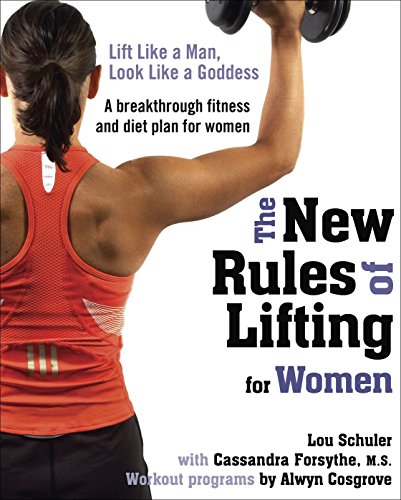
The New Rules of Lifting for Women: Lift Like a Man, Look Like a Goddess, by Lou Schuler, Cassandra Forsythe M.S., Alwyn Cosgrove

The New Rules of Lifting for Women: Lift Like a Man, Look Like a Goddess, by Lou Schuler, Cassandra Forsythe M.S., Alwyn Cosgrove


The New Rules of Lifting for Women: Lift Like a Man, Look Like a Goddess, by Lou Schuler, Cassandra Forsythe M.S., Alwyn Cosgrove

Ebook The New Rules of Lifting for Women: Lift Like a Man, Look Like a Goddess, by Lou Schuler, Cassandra Forsythe M.S., Alwyn Cosgrove

Why must wait for some days to obtain or obtain guide The New Rules Of Lifting For Women: Lift Like A Man, Look Like A Goddess, By Lou Schuler, Cassandra Forsythe M.S., Alwyn Cosgrove that you buy? Why should you take it if you can get The New Rules Of Lifting For Women: Lift Like A Man, Look Like A Goddess, By Lou Schuler, Cassandra Forsythe M.S., Alwyn Cosgrove the quicker one? You could locate the same book that you purchase here. This is it guide The New Rules Of Lifting For Women: Lift Like A Man, Look Like A Goddess, By Lou Schuler, Cassandra Forsythe M.S., Alwyn Cosgrove that you can obtain directly after buying. This The New Rules Of Lifting For Women: Lift Like A Man, Look Like A Goddess, By Lou Schuler, Cassandra Forsythe M.S., Alwyn Cosgrove is well known book around the world, of course many people will aim to have it. Why do not you become the very first? Still confused with the method?

This The New Rules Of Lifting For Women: Lift Like A Man, Look Like A Goddess, By Lou Schuler, Cassandra Forsythe M.S., Alwyn Cosgrove is very appropriate for you as beginner reader. The readers will consistently start their reading habit with the favourite theme. They may not consider the author and author that produce the book. This is why, this book The New Rules Of Lifting For Women: Lift Like A Man, Look Like A Goddess, By Lou Schuler, Cassandra Forsythe M.S., Alwyn Cosgrove is really right to check out. However, the idea that is given up this book The New Rules Of Lifting For Women: Lift Like A Man, Look Like A Goddess, By Lou Schuler, Cassandra Forsythe M.S., Alwyn Cosgrove will reveal you numerous points. You could begin to love additionally reviewing till completion of guide The New Rules Of Lifting For Women: Lift Like A Man, Look Like A Goddess, By Lou Schuler, Cassandra Forsythe M.S., Alwyn Cosgrove.

Additionally, we will certainly discuss you guide The New Rules Of Lifting For Women: Lift Like A Man, Look Like A Goddess, By Lou Schuler, Cassandra Forsythe M.S., Alwyn Cosgrove in soft data kinds. It will not disturb you to make heavy of you bag. You need only computer tool or device. The link that we offer in this website is available to click and after that download this The New Rules Of Lifting For Women: Lift Like A Man, Look Like A Goddess, By Lou Schuler, Cassandra Forsythe M.S., Alwyn Cosgrove You recognize, having soft file of a book The New Rules Of Lifting For Women: Lift Like A Man, Look Like A Goddess, By Lou Schuler, Cassandra Forsythe M.S., Alwyn Cosgrove to be in your gadget could make ease the viewers. So through this, be a good reader currently!

Simply hook up to the internet to get this book The New Rules Of Lifting For Women: Lift Like A Man, Look Like A Goddess, By Lou Schuler, Cassandra Forsythe M.S., Alwyn Cosgrove This is why we suggest you to use as well as utilize the industrialized innovation. Checking out book doesn't mean to bring the printed The New Rules Of Lifting For Women: Lift Like A Man, Look Like A Goddess, By Lou Schuler, Cassandra Forsythe M.S., Alwyn Cosgrove Established technology has actually enabled you to check out only the soft file of the book The New Rules Of Lifting For Women: Lift Like A Man, Look Like A Goddess, By Lou Schuler, Cassandra Forsythe M.S., Alwyn Cosgrove It is exact same. You could not should go and also obtain traditionally in looking guide The New Rules Of Lifting For Women: Lift Like A Man, Look Like A Goddess, By Lou Schuler, Cassandra Forsythe M.S., Alwyn Cosgrove You may not have adequate time to invest, may you? This is why we give you the most effective means to obtain guide The New Rules Of Lifting For Women: Lift Like A Man, Look Like A Goddess, By Lou Schuler, Cassandra Forsythe M.S., Alwyn Cosgrove now!

The New Rules of Lifting for Women: Lift Like a Man, Look Like a Goddess, by Lou Schuler, Cassandra Forsythe M.S., Alwyn Cosgrove

In The New Rules of Lifting for Women, authors Lou Schuler, Cassandra Forsythe and Alwyn Cosgrove present a comprehensive strength, conditioning and nutrition plan destined to revolutionize the way women work out. All the latest studies prove that strength training, not aerobics, provides the key to losing fat and building a fit, strong body. This book refutes the misconception that women will "bulk up" if they lift heavy weights. Nonsense! It's tough enough for men to pack on muscle, and they have much more of the hormone necessary to build muscle: natural testosterone. Muscles need to be strengthened to achieve a lean, healthy look. Properly conditioned muscles increase metabolism and promote weight loss -- it's that simple. The program demands that women put down the "Barbie" weights, step away from the treadmill and begin a strength and conditioning regime for the natural athlete in every woman. The New Rules of Lifting for Women will change the way women see fitness, nutrition and their own bodies.

  • Sales Rank: #15938 in Books
  • Brand: imusti
  • Published on: 2009-12-26
  • Released on: 2008-12-26
  • Original language: English
  • Number of items: 1
  • Dimensions: 9.20" h x .60" w x 7.60" l, 1.13 pounds
  • Binding: Paperback
  • 272 pages
Features
  • Avery Publishing Group

Review
aLou Schuler has finally written a training book for me, and for all women. His expert advice, no-nonsense plans, and sense of humor are reassuring, motivating, and entertaining. Iam starting the program tomorrow!a
a Susan Kleiner, Ph.D., author of "Power Eating" and "The Good Mood Diet"
aThe workouts in this book are unique, challenging, and extremely effectivea]be prepared to get into the best shape of your life!a
aValerie Waters, celebrity trainer


?Lou Schuler has finally written a training book for me, and for all women. His expert advice, no-nonsense plans, and sense of humor are reassuring, motivating, and entertaining. I?m starting the program tomorrow!?
? Susan Kleiner, Ph.D., author of "Power Eating" and "The Good Mood Diet"

?The workouts in this book are unique, challenging, and extremely effective?be prepared to get into the best shape of your life!?
?Valerie Waters, celebrity trainer


"Lou Schuler has finally written a training book for me, and for all women. His expert advice, no-nonsense plans, and sense of humor are reassuring, motivating, and entertaining. I'm starting the program tomorrow!"
- Susan Kleiner, Ph.D., author of "Power Eating" and "The Good Mood Diet"
"The workouts in this book are unique, challenging, and extremely effective...be prepared to get into the best shape of your life!"
--Valerie Waters, celebrity trainer


About the Author
Lou Schuler is a National Magazine Award-winning journalist, a certified strength and conditioning specialist, the author of popular diet and strength-training books, and a dedicated blogger. He has written and edited Men's Fitness, Men's Health, Men's Health Muscle, Men's Journal, and other magazines. Alwyn Cosgrove is co-owner, with his wife Rachel, of Results Fitness in Newhall, California. He is a professional member of the National Academy of Sports Medicine and the American College of Sports Medicine, among other organizations, and is a frequent contributor to a variety of magazines, including Men's Health and Men's Fitness. Cassandra Forsythe, M.S., is a doctoral student at the University of Connecticut, studying exercise science and nutrition. She is an expert consultant for fitness and nutrition media, including Men's Health, Fitness Rx for Her, and Fitness Rx for Him.

Excerpt. © Reprinted by permission. All rights reserved.
Why Should a Woman Lift Like a Man?


If you’ve ever watched a man working out in a gym, you can be forgiven for not immediately recognizing the bountiful lessons he has to offer. Instead, if you observed anything, it was probably one or more of these:


   • poor form
   • overly optimistic weight selection, resulting in even poorer form
   • odd, guttural noises, usually uttered while lifting too much weight with poor form
   • a sudden inability to lift those weights after 8 to 12 repetitions (done with good or bad form), resulting in a pile of iron on the floor and an empty slot on the rack where those weights belong
   • a curious attraction to the bench press, which not only results in all of the aforementioned problems, but also is performed with a dedication and zeal that leave no time for exercises designed to work the muscles he can’t see in a mirror
   • an even more curious lack of awareness that other people can see the muscles that don’t show up in his mirror

So what in the world can you learn from the average meathead in your local health club? A lot. I won’t pretend that men do anything better than women in the weight room. But I think they understand a few concepts that women tend to ignore.

These are by far the most important of all the new rules I’ll list in this book.

NEW RULE #1 • The purpose of lifting weights is to build muscle

Weight-training advice for women revolves around what I call the three dirty words: toning, shaping, and sculpting. “Tone,” short for “tonus,” has a specific meaning in exercise science: it’s the firmness of any given muscle when you aren’t deliberately flexing it. Tonus improves when you train with weights, but it’s not anything you can see.

The way “toning” is used in books and magazines catering to women, and then by women themselves, it means “make your muscles look better without making them bigger.” The idea is that there are specific types of workouts—usually involving lots of repetitions with light weights—that will help you achieve this.

But that’s not a realistic or healthy way to look at your muscles. If the weights are unchallenging, your muscles won’t grow. If your muscles don’t grow, they won’t look any better than they do now, even if you could somehow strip off whatever fat sits on top of them.

This is such an important point that I’ll repeat it:

With or without excess fat, your body simply will not look healthy and fit without well-trained muscle tissue.

“Shaping” offers a different but equally unlikely promise. Muscles can’t be “shaped.” Their shape is determined by your genetics. You can make them bigger or smaller, and if you’re a talented and dedicated bodybuilder you can change their size in proportion to the size of nearby muscles. In other words, you can certainly reshape your body by making some things bigger and other things smaller. But you can’t change the shape of individual muscles.

“Sculpting” is the most meaningful of the three words. It implies a combination of muscle growth and fat loss that leaves the lifter’s physique looking . . . well, sculpted.

But you can’t “sculpt” muscles you haven’t yet built.

NEW RULE #2 • Muscle is hard to build

When I started lifting weights, back when I was a ridiculously weak and scrawny thirteen-year-old boy who dreaded the humiliation of removing his shirt at the local swimming pool, I dreamed of having muscles roughly the size of the muscles I have now. If you had told me I’d someday be a fairly solid 185-pounder, thanks to the weights, I would’ve said, “I’m in!”

But if you’d added the caveat that it would take more than three decades to reach that size, I might’ve had some reservations.

I’ve never once walked into the gym thinking, “Today I’m going to try to not get too big.” For most guys, when we’re talking about muscles, there’s no such thing as “too big.” Those of us who train drug-free celebrate each pound of muscle we add, and every millimeter of upper-arm girth. Some guys even obsess over the circumference of their necks. Why? Because we know that it’s really hard to put on muscle size, it never happens by accident, and every bit of it is a sign of success against all odds. And that’s with all the hormonal advantages that nature gives to men.

Meanwhile, women, naturally deprived of the amounts of testosterone that would make muscle-building a more straightforward pursuit, worry endlessly about adding so much muscle that they’ll turn into the type of shemale you rarely encounter outside The Howard Stern Show.

So this brings me to the fourth dirty word: “bulky.” As in, “I don’t want to get too bulky.”

I’ll say this as simply as I can:

Unless you’re an extreme genetic outlier, you can’t get too bulky.

Your body won’t allow it. If you put on 10 pounds of muscle in Alwyn’s six month program, you’ll be at the top of the class. And if you don’t take off at least 10 pounds of fat with the combination of Alwyn’s workouts and Cassandra’s nutrition plans, I’ll be surprised. The most likely outcome, assuming you’re willing to work hard, is that you’ll come away with a small net loss in body weight, but a dramatic difference in the way your body looks in the mirror and the way your clothes fit. Your tops should be a little tighter, especially in the shoulders, and your trousers a bit roomier, particularly around the waist.

What you don’t have to worry about is getting too big. I’ve been lifting weights longer than many of you have been alive, and I’m still waiting for that moment when I look in the mirror and say, “Damn it, I’m just too big!”

NEW RULE #3 • Results come from hard work

This is a somewhat redundant rule, given that I mentioned hard work in the previous one. But here’s something I’ve observed over my many years of hanging around in gyms: A woman who’s willing to work like a galley slave in Spinning class, twist herself into Gordian knots in the yoga studio, and build enough core strength with Pilates to prop up a skyscraper will walk into the weight room, pick up the pastelcolored Barbie weights, and do the exact opposite of what will give her the results she wants.

I’ll tell a story that illustrates what I mean:

As I was writing this chapter, I observed a woman at my gym doing two exercises in combination. The first was triceps kickbacks, a simple and useless exercise in which you lean over a bench, hold your upper arm parallel to the floor, and straighten your elbow while holding a very light weight. The second was one-arm rows, in which you lean over a bench with your upper arm perpendicular to the floor, and row the weight up to the side of your abdomen.

A rowing exercise involves far more muscles, including the lats and trapezius, the big, strong muscles of the upper back. Plus, since it’s a multijoint exercise, the muscles that bend the elbow, such as the biceps, are also involved. And in addition to all that, the leverage on a one-arm row is perfect for lifting relatively heavy weights—you have one foot on the floor, and the opposite knee and hand braced on the bench. There’s no stress on your lower back, and it’s not unusual to see serious bodybuilders doing this exercise with a dumbbell weighing 100 pounds or more.

The kickback, meanwhile, is an awkward exercise, with relatively poor leverage. The only movement is at the elbow joint, which is not designed to move heavy weights at that angle. Even a beginner would probably be able to use three or four times as much weight on a row versus a kickback.

This woman was using 6-pound dumbbells for the kickbacks . . . and 7-pound weights for the rows.

I asked a trainer at the gym if he’d seen what I’d just seen. He shook his head sadly, and said that the toughest part of his job was getting women to use weights heavy enough to make their time in the gym worthwhile.

So even if a woman understands the first two rules in this chapter—that the object of lifting is to build muscle, and that muscle is hard to build—the idea that she truly needs to challenge herself in the weight room may not get through.

NEW RULE #4 • Hard work includes lifting heavier weights

It’s not enough to progress from lifting the Barbie ’bells fifteen times to lifting them twenty times. It may be an accomplishment—that is, the result of purposeful and exhausting work—but it’s not going to make muscles bigger.Muscles grow for a variety of reasons, but the main one is strength. If you force them to get stronger, they will get bigger. If you start lifting 100 pounds five times, but train your body to lift 150 pounds five times, you’re going to end up with bigger muscles. But if you start off lifting 50 pounds ten times, and progress to lifting the same 50 pounds fifteen times, all you’ve done is increase the endurance of the muscles, which by itself will not make them bigger.

NEW RULE #5 • From time to time, you have to break some of the old rules

You’ll rarely see a woman lifting weights with bad form in a gym. And you’ll almost always see at least one man slinging iron around with technique so miserably wrong you want to dial 9 and 1 on your cell phone just to save time when the inevitable spine-buckling accident occurs.

In between the extremes, you’ll see lots of guys pushing themselves out to the edge of acceptable form to get an extra repetition in their final set of an exercise, or to hit a new personal record on a lift. If nothing else, you’ll probably see guys lift at a variety of speeds, perhaps shifting into a faster gear near the end of a set to help them complete more repetitions. The more experienced a male lifter is, the more he learns to trust his own body and his own instincts. (Alas, inexperienced lifters often feel the same way, even if their instincts haven’t yet earned that trust.)

But you’ll rarely see a woman deviate from the textbook description of the exercise. And when it comes to the tempo of her lifts, she performs them like clockwork, even if it means she has to use unchallenging weights to make such precision possible. I’d never advocate lifting with bad form. But there’s more to strength training than coloring inside the lines.

Part of the problem is fear. When women are introduced to the weight room, they’re taught that there’s only one way to perform each exercise, and that small adjustments to accommodate individual biomechanics will put her in the ER. If anybody tries to instill such fear in a man, the sound magically stops before it reaches his eardrums.

To make things worse, women are sometimes presented with cautions that have little basis in the real world, creating fear of injury when the actual risk is nonexistent.

For example, in the book Body for Life for Women, the author offers this instruction for a simple shoulder press: “Press the weights up until your arms are almost straight (with your elbows just short of locked).” Since the author is Pamela Peeke, M.D., and not some garden-variety personal trainer or celebrity who decided to expand her investment portfolio by writing a workout book, you’d assume the antielbow- straightening precaution has a basis in science. That is, straightening your arms at the elbow joints must be bad for you.

It’s not.

In all my years of writing about strength training, and in all my months of studying for my credentials as a trainer, I’ve never come across any suggestion of injury risk from this simple movement. More to the point, elbows are supposed to lock. It’s called “straightening your arms.” The triceps muscles are designed to straighten your elbows until they reach that locked position. If you don’t lock, you don’t work your triceps through their full range of motion, which means you don’t get the full benefits of the elbow-straightening exercise you’re performing.

My issue here isn’t with the idea that people should exercise with caution, and I’m not arguing for more reckless abandon in the weight room.What I am saying is that your body has natural movement patterns, which support a range of variations. Maybe all strength-training precautions can be reduced to these two sentences: If it’s what your body was designed to do, it’s probably not bad form. And if the exercise requires you to do something unnatural, you should think twice before doing it.

How to Feel Like a Natural Woman

I realize that the word “natural” isn’t always helpful in early twenty-first-century America, where humans spend much of the day sitting at desks or driving cars, two actions that no one would argue our bodies evolved to perform. To me, a “natural” position or movement is one you would assume or perform in an athletic activity.

Picture yourself playing volleyball, getting ready to return the other team’s serve. Your feet are parallel to each other, perhaps shoulder-width apart, with toes pointed forward. Your knees are bent slightly. (You’d never play any sport with stiff knees; you’d be virtually immobile.) Your lower back is arched slightly. Your shoulders are square, and your midsection’s tight. That’s what a human body looks like when it’s ready for physical action, whether that action is a game, a hunt, or a wrestling match.

Now picture a typical woman standing at the cable station in a typical gym, getting ready to perform triceps extensions. (In case you’re new to lifting, the extension is an elbow-straightening exercise, usually done with a straight bar attached to the cable.) Her feet are together, her knees are locked, her lower back is flat, and her shoulders are hunched up toward her ears. In other words, she’s in the opposite of an athletic position, despite the fact she’s about to do an exercise that, in theory, will make her body more athletic.

NEW RULE #6 • No workout will make you taller

Workout advice for women is riddled with allusions to making muscles “longer.” I started noticing it a few years ago at the front end of the Pilates craze. In fact, I was on a panel at a conference with an editor from a women’s magazine who, in discussing fitness trends, said that women didn’t want to build “bulky” muscles; instead, they wanted “long, lean muscles, like a dancer’s,” and they could get these muscles from Pilates.

I started laughing (not my most gracious moment, I admit), and wondered if I should start telling my readers at Men’s Health that our workouts could make them taller. The poor woman looked stunned; I don’t think it had occurred to her that her pro-Pilates sentiments were nothing more than propaganda.

The reality is this: muscles, as aforementioned, have a genetically predetermined shape. If you train and feed a muscle so that it grows, you can’t choose whether the muscle becomes “bulky” or “long and lean, like a dancer’s,” any more than you can choose your own height. I won’t claim men are inherently reality-based—I’ve gotten e-mails from more than one guy asking how he can get “ripped abs, like Brad Pitt” (my answer: “For starters, you’ll need his parents”)—but I’ve never had anyone ask me how he can make his muscles “longer.” It just doesn’t occur to guys to think of their bodies as being that malleable.

That said, I think both genders fall for the entirely fallacious notion that by doing a particular person’s workout, they can have a physique like that person. Anyone in the business of publishing bodybuilding magazines will tell you that the surest way to sell more copies than usual is to slap a black-and-white picture of Arnold Schwarzenegger on the cover, and promise Schwarzeneggerian results with the workout routine inside. For some reason, it never occurs to anyone that Arnold was the only guy in the history of bodybuilding who ever looked like Arnold. Logically, that suggests a oneof- a-kind quirk in Schwarzenegger’s genetic code, something that allowed him to achieve unique physical proportions that were simply unattainable by anyone else. Same goes for whichever model or actress is on the cover of Shape or Fitness or Self this month. You can use their “Exclusive Stay-Slim Workout Secrets!” from now till doomsday, but there’s not a chance in a million you’ll emerge with a belly, shank, or rump like that celebrity unless your genetics allow it.

Another idea I’d like to dispel, while I’m at it:

Let’s say you accept the impossibility of developing a celebrity’s proportions without being a clone of that celebrity. Chances are, you still believe that you can achieve a “type” of physique if you train like people who have that type. Magazines feed this notion, rarely stated in so many words, by showing tall, lean models doing workouts that promise readers a long, lean physique.

Of course, this makes perfect sense from the magazines’ point of view. They aren’t going to sell many copies if they show short, chunky women in their workout features. But you have to understand that the models doing the workouts are just that. They were cast by the photo editors specifically because they already have what the feature promises. If the exercises in the feature are unique, you can bet the model is doing them for the first time. She had that body when she walked in the door of the photo studio, and she’ll still have it when she walks out. That’s why she’s a model. An obvious point? Okay. But raise your hand if you believe that running will make you look like a runner. If your hand isn’t in the air, you’re probably not being honest with yourself. Don’t you believe that running makes you lose weight, and that successful runners are skinny because they run? Isn’t that why you, or people you know, turn to endurance exercise as the first step in a weight-loss program? I’m not going to tackle the myths and realities of long-distance locomotion until Chapter 3, and I won’t for a second argue that women are more susceptible to the seductive strains of “Build a Dancer’s Body!” than men are to the testosterone-soaked dream of “Build Arms Like Arnold’s!”

But if we don’t start this relationship with a firm grasp of the reality of our undertaking, it’s just not going to work. And if it doesn’t work, you’ll go right back to toning, shaping, and sculpting, not to mention living in fear of being bulky. Even worse, if things really go bad, I may have to go back to writing articles about Brad Pitt’s abs. Nobody wants that.


Most helpful customer reviews

93 of 95 people found the following review helpful.
I have discovered that I don't always have to eat like a bird or cut out all my grains or ...
By T. Sun
I was lent this book to try out, and later bought this book for myself. This was the first program that I've ever followed. The routine goes on for about 6 months. With breaks and visits out of town, I took over 7 months. Prior to this book, I was one of those cardio addicts who spent all my time on the machines at the gym. With dieting and cardio, I lost about 30 lbs. Then as some people who still have a long ways to go might realize, cardio alone will eventually stop working. The body will get accustomed to that hour a day of biking, or treadmilling, etc. That is my personal discovery. And any diet plan proved difficult to follow for long term. Don't get me wrong, I am eating much healthier than ever, but my point is, life doesn't have to be all about a "perfect" diet. With lifting, I have discovered that I don't always have to eat like a bird or cut out all my grains or carbs, etc.

I had been wanting to start a weight lifting routine for a few months before I started the program in this book. I started in January of 2015. I didn't follow any specific diet, nor did I follow the recommended meal plans. I think if I had, I might have seen even more progress. The exercises in the program started off very basic, perfect for a beginner like myself. Then there were workouts that made me sore in places that I didn't know I had muscle. The workouts are demanding, but fun. I did exercises that a beginner like myself didn't know existed, but when I did them, I really felt the soreness later. I would say that these workouts are challenging, however with some determination, the routines are all doable for a beginner.

Now that I am finished with the program, I can report on some of my results and thoughts about it. After I had finished the program and immediately moved onto another one, I could really tell the difference between the routines in this program vs. routines in other programs. These workouts made me feel like I was constantly working out muscles that I don't often workout, making me feel stronger and with more stability. This book focuses on health and strength, which it really delivers. There are lots of compound movements, which is why I often felt like my body was tired but in no specific area afterwards. The quads will end up burning a lot. I became much stronger after this workout. My deadlift and squat numbers all started out with weights that were less than the 45lb bar. By the end, I was deadlifting 135 at one rep max, and squatting about 95 lbs.

Visually, I got compliments by many people that I was noticeably looking better. I lost more than an inch off my waist, and I started to see curves on my apple-shaped body. The weird thing is, I actually didn't lose too much weight - about 7 lbs. So imagine my surprise when I got all those compliments. Trust me, what matters are the inches that are shedding off of your problem areas! Again, I haven't followed a diet or cut any carbs. I ended up counting my daily calories and apparently that's quite enough.

There is one hang-up I have on this program. I started out on the program about 25-30 lbs overweight. In this way, I felt that perhaps the book wasn't exactly written for me. The book does not place a lot of emphasis on cardio. I am not passionate about cardio either, however in my opinion, as someone who was 25-30 lbs overweight, some cardio is still necessary. During the beginning of the program, I was doing mainly the HIIT cardio like the book illustrates. However, I started to lose MORE body fat when I began to do the steady state cardio at medium intensity for over 45 minutes again. Of course, I hear that HIIT works wonders for some people. It's just not enough cardio for my body. That's a learning process that I'm still trying out for myself.

Overall, I owe my high regards to this book after my full year of my life in lifting. I am sad for the people who can't follow this book. Exercise tapes are nice and provide good workouts, however books like this are educating for a lifetime of health awareness. The general fitness or health industry is a lot of flashiness, promising fast results and amazing changes. Most of these marketing pitches don't work in the long run. (Believe me, I've tried them all.) I personally am liking going to the arm curl section of the gym and scrapping for the squat rack. I am considering other programs from this book series later on. If there is an intermediate or advanced book for women available, I am on it.

5 of 5 people found the following review helpful.
Great book for all levels!
By A little bit of everything
This book has it all, an introduction explaining basic principles of strength training and the differences between men and women, diet and food section, lifting section and a meal plan/recipes.

Okay when I started reading the book introduction and the talk on calories I'll admit I scoffed a bit at how many calories he suggested and thought myself in superior in planning a 1200 calorie diets and doing maximum exercise to drop my last twenty pounds. After food binging in the afternoon and suffering through some dizzy spells I realized I obviously wasn't doing it right. Since then and doing additional research I am realizing everything this author is talking about is the best way of attacking those last pounds and getting into the best shape.

For starters this book does not advocate fast quick weight loss with dangerously low calories diets because not only is that not healthy but for those of us who struggle it's not feasible in the long run. I think I read a reviewer argue that this book plans for too many calories but I disagree out bodies need soo much more than we realize especially if we are planning for cardio and building muscle. The author gives a simple formula in figuring how much calories you'll need to fuel your body and lose weight without starving.

I love to have things spelled out for me and with the exercise plan he does that in mapping out what exercised to do and when. The idea is to lift heavy so you can shorten the time you spend exercising. I admit I did feel a little self conscious at the gym but I practiced at home and then took it to the gym. To lift safely trying out his exercises I do strongly recommend that you go online and watch trusted online video demonstrations of the proper technique, in the long run this might save you from injury.

So far with the recipes I have tried the protein shakes and they are not half bad, I plan on following the meal plan as well.

I cannot tell you how many people in different online forums have recommended this book, so let me add my voice and say you can learn so much.

0 of 0 people found the following review helpful.
Get it! & learn to lift like a man!
By Ms. Austen
I'm currently on the last stage (planning to repeat this stage). And in between lots of travel I've been doing this for about 7 months. And just last night I noticed my quads popping (while flexing of course) and it's all because of NROL4W.

I still have a bit of body fat to lose but the fact that my biceps, calves & quads are visible is wonderful. I started with the bar on squats now I do 135lb for 3 sets of 8 or 105 for 2 sets of 20. I PR around 160.

So definitely worth it if you're looking to get into lifting and there are blank worksheets online for this book.

I don't follow the nutrition (I now have a coach for that) but I'm happy with my progress none the less.

See all 629 customer reviews...

The New Rules of Lifting for Women: Lift Like a Man, Look Like a Goddess, by Lou Schuler, Cassandra Forsythe M.S., Alwyn Cosgrove PDF
The New Rules of Lifting for Women: Lift Like a Man, Look Like a Goddess, by Lou Schuler, Cassandra Forsythe M.S., Alwyn Cosgrove EPub
The New Rules of Lifting for Women: Lift Like a Man, Look Like a Goddess, by Lou Schuler, Cassandra Forsythe M.S., Alwyn Cosgrove Doc
The New Rules of Lifting for Women: Lift Like a Man, Look Like a Goddess, by Lou Schuler, Cassandra Forsythe M.S., Alwyn Cosgrove iBooks
The New Rules of Lifting for Women: Lift Like a Man, Look Like a Goddess, by Lou Schuler, Cassandra Forsythe M.S., Alwyn Cosgrove rtf
The New Rules of Lifting for Women: Lift Like a Man, Look Like a Goddess, by Lou Schuler, Cassandra Forsythe M.S., Alwyn Cosgrove Mobipocket
The New Rules of Lifting for Women: Lift Like a Man, Look Like a Goddess, by Lou Schuler, Cassandra Forsythe M.S., Alwyn Cosgrove Kindle

The New Rules of Lifting for Women: Lift Like a Man, Look Like a Goddess, by Lou Schuler, Cassandra Forsythe M.S., Alwyn Cosgrove PDF

The New Rules of Lifting for Women: Lift Like a Man, Look Like a Goddess, by Lou Schuler, Cassandra Forsythe M.S., Alwyn Cosgrove PDF

The New Rules of Lifting for Women: Lift Like a Man, Look Like a Goddess, by Lou Schuler, Cassandra Forsythe M.S., Alwyn Cosgrove PDF

Jumat, 20 Desember 2013

[M450.Ebook] Download PDF The Misadventures of Awkward Black Girl, by Issa Rae

Download PDF The Misadventures of Awkward Black Girl, by Issa Rae

As one of guide compilations to recommend, this The Misadventures Of Awkward Black Girl, By Issa Rae has some strong factors for you to check out. This publication is quite suitable with just what you need currently. Besides, you will certainly likewise enjoy this publication The Misadventures Of Awkward Black Girl, By Issa Rae to check out considering that this is one of your referred books to check out. When going to get something new based upon encounter, enjoyment, and also various other lesson, you can utilize this book The Misadventures Of Awkward Black Girl, By Issa Rae as the bridge. Starting to have reading habit can be undergone from various means and from variant kinds of books

The Misadventures of Awkward Black Girl, by Issa Rae

The Misadventures of Awkward Black Girl, by Issa Rae


The Misadventures of Awkward Black Girl, by Issa Rae

Download PDF The Misadventures of Awkward Black Girl, by Issa Rae

Envision that you obtain such particular outstanding encounter and also expertise by just checking out a book The Misadventures Of Awkward Black Girl, By Issa Rae. Just how can? It appears to be higher when an e-book could be the most effective thing to uncover. Publications now will certainly show up in published as well as soft documents collection. One of them is this publication The Misadventures Of Awkward Black Girl, By Issa Rae It is so normal with the printed publications. Nonetheless, several people often have no area to bring the e-book for them; this is why they can not check out guide anywhere they want.

Reading book The Misadventures Of Awkward Black Girl, By Issa Rae, nowadays, will certainly not force you to always get in the store off-line. There is an excellent area to get guide The Misadventures Of Awkward Black Girl, By Issa Rae by on-line. This website is the very best site with whole lots numbers of book collections. As this The Misadventures Of Awkward Black Girl, By Issa Rae will certainly remain in this publication, all publications that you need will certainly be right below, as well. Simply search for the name or title of guide The Misadventures Of Awkward Black Girl, By Issa Rae You could discover exactly what you are searching for.

So, even you require obligation from the company, you might not be perplexed more considering that books The Misadventures Of Awkward Black Girl, By Issa Rae will consistently assist you. If this The Misadventures Of Awkward Black Girl, By Issa Rae is your best companion today to cover your task or work, you can when feasible get this book. Just how? As we have told previously, just see the link that our company offer below. The conclusion is not only the book The Misadventures Of Awkward Black Girl, By Issa Rae that you look for; it is how you will certainly obtain several publications to sustain your skill and also capability to have great performance.

We will show you the very best as well as easiest method to obtain book The Misadventures Of Awkward Black Girl, By Issa Rae in this world. Lots of collections that will certainly support your responsibility will certainly be right here. It will make you really feel so perfect to be part of this internet site. Becoming the member to always see exactly what up-to-date from this book The Misadventures Of Awkward Black Girl, By Issa Rae website will certainly make you really feel right to look for guides. So, just now, and below, get this The Misadventures Of Awkward Black Girl, By Issa Rae to download and install as well as save it for your valuable deserving.

The Misadventures of Awkward Black Girl, by Issa Rae

In the bestselling tradition of Sloane Crosley’s I Was Told There’d Be Cake and Mindy Kaling’s Is Everyone Hanging Out Without Me?, a collection of humorous essays on what it’s like to be unabashedly awkward in a world that regards introverts as hapless misfits, and black as cool.

My name is “J” and I’m awkward—and black. Someone once told me those were the two worst things anyone could be. That someone was right. Where do I start?

Being an introvert in a world that glorifies cool isn’t easy. But when Issa Rae, the creator of the Shorty Award–winning hit series “The Misadventures of Awkward Black Girl,” is that introvert—whether she’s navigating love, work, friendships, or “rapping”—it sure is entertaining. Now, in this debut collection of essays written in her witty and self-deprecating voice, Rae covers everything from cybersexing in the early days of the Internet to deflecting unsolicited comments on weight gain, from navigating the perils of eating out alone and public displays of affection to learning to accept yourself—natural hair and all.

A reflection on her own unique experiences as a cyber pioneer yet universally appealing, The Misadventures of Awkward Black Girl is a book no one—awkward or cool, black, white, or other—will want to miss.

  • Sales Rank: #98124 in Books
  • Published on: 2015-02-10
  • Released on: 2015-02-10
  • Original language: English
  • Number of items: 1
  • Dimensions: 9.00" h x .80" w x 6.00" l, .0 pounds
  • Binding: Hardcover
  • 224 pages

Review
“I loved this book. Issa Rae is brilliant, funny and loveably awkward.” (Mindy Kaling Is Everyone Hanging Out without Me?)

"If you like Awkward and love Black. Or love Awkward and like Black. Or if you're like me and just can't get enough of Awkward and Black in equal doses, then you will love love love Issa Rae and her Awkward Black Girl tales of Awkward Black Girlishness. That wasn't too awkward was it?" (Larry Wilmore The Senior Black Correspondent on The Daily Show and host of Minority Report)

About the Author
With her own unique flare and infectious sense of humor,�Issa�Rae’s content has garnered more than twenty-five million views and more than 200,000 subscribers on YouTube. In addition to making the Forbes “30 Under 30” list twice and winning the 2012 Shorty Award for Best Web Show for her hit series The Misadventures of Awkward Black Girl,�Issa�Rae has worked on web content for Pharrell Williams, Tracey Edmonds, and numerous others. She developed a TV series with Shonda Rhimes for ABC and is currently developing a half-hour comedy, Insecure, for HBO. Issa has received national attention with major media outlets including The New York Times, CNN, Elle, Seventeen, Rolling Stone, VIBE, Fast Company, MSNBC, Essence, and more.

Excerpt. � Reprinted by permission. All rights reserved.
The Misadventures of Awkward Black Girl
A/S/L

At only eleven years of age, I was a cyber ho. Looking back, I’m embarrassed. For me. For my parents. But oddly enough, my cyber social debauchery is indirectly correlated with my current status as a so-called internet pioneer. It all started when I began catfishing—creating characters and transmitting them over the internet—though back then people just called it “lying.” Had my father not signed my entire family up with America Online �accounts for the computer in our modest Potomac, Maryland, home I don’t know that I’d have had the tools to exploit the early ages of the internet.

Two years earlier, my oldest brother, Amadou, had gone away to college at Morehouse, freeing up the coveted computer, which was housed in the basement, for my use. Before he decamped for college, I would spend hours at a time watching him type the commands into MS-DOS that would transport us to the magical kingdom of Sierra’s King’s Quest VI on our IBM. I never had a strong desire to play the game myself—I always assumed I wasn’t smart enough to play it on my own—until Amadou graduated from the house and I no longer had anyone to excitedly observe. I looked up to my oldest brother as the epitome of intelligence. He knew everything, though he was too humble to be ostentatious with his knowledge as I would have been had I been as smart. So I simply observed. At eighteen, he was an official adult, and he had a duty to selflessly spread his intelligence to the world, other people’s younger sisters included. His absence left a void in my heart and in the basement, particularly where the use of the computer was concerned.

I wasn’t next in line for the computer, but my second-oldest brother, Malick, was too preoccupied with football, girls, and high school to care. He’d occasionally make use of it for term papers and Tetris, but otherwise, it was mine for the taking. Using the computer wasn’t foreign to me, by any means. I had an old Apple computer in my very own room (a double source of jealousy for my younger brother), where I played Number Munchers and self-published my stories on perforated paper from an excruciatingly noisy printer.

“Jo-Issa, are you wasting paper again?!” my mother would yell from her makeshift home office, tipped off by the mechanical snitch. When alone, and mom-approved, I actually loved to hear the robotic crunching and whirring that the printer made while laying to ink my very own written words. But the computer in my room paled in comparison to the one downstairs, in the basement. For one thing, the large floppy disks—I think they were actually called hard disks, what the f%4# 90s?—were becoming extinct, and rightfully so, since the data on those things could be lost with the smudge of a finger. And since my computer took only the “hard” disks, my game choices were limited to nerdy learning games and text-based adventure games with no visuals. BLECH. BORING. BOO.

The other reason my computer wasn’t a huge triumph for my preteen self-discovery was because it lacked a modem, which meant no dial-up internet for me. But AOL changed my life. Specifically, it changed my social life. To be more precise: AOL gave me a social life. It ignited my social development and expanded my concept of sexuality. Because of AOL, I had imaginary friends that weren’t imaginary. I had elaborate conversations devoid of awkward silences. And, perhaps most valuable of all, I could actually talk to boys. At my command!

Before my parents caught wind of frightening news reports of child predators, I spent my days and after-school evenings in chat rooms, learning to speed read, talking to kids my age who were also ahead of the curve. Or pedophiles, who were remarkably creative and persistent in their forbidden pursuit. Pedos actually had it made in the mid-nineties, before the media exposed them. Talk about the glory days.

My friends at school, other fifth graders, didn’t seem to relate when I mentioned “chat rooms” and “profiles” or when I sang along to the dial-up internet song I made up in my head. It seemed that, for a brief moment, only I was privy to this alternate American universe that lived online.

By the time my family moved to Los Angeles to join my dad, a pediatrician, who had seized an opportunity to open his own family clinic there, my relationship with the computer had grown immensely, much to the dismay and irritation of my mother.

“You’re always on the computer! Go do your homework.”

“I already finished.”

“Well then, go outside and play!”

She just didn’t get it. Only recently, in my late twenties, did she come to realize that my excessive computer use is what led me to becoming the self-employed, almost-focused career woman I am today.

By the summer of 1996, more of my friends from Maryland had adopted AOL. It helped us bridge the three thousand miles between us. By then, I was already over the handwritten letters of yesteryear. That was a form of communication of the third world, reserved for pen pals from Ghana and Spain. Besides, the “You’ve Got Mail” greeting was way more exciting than the dead silence of receiving a letter. Exclaiming, “I’ve got mail!” in the foyer to yourself isn’t the same—trust me.

It was through electronic mail that I’d tell my friends back home about my Hollywood adventures. Never mind the fact that I lived in Windsor Hills, thirty minutes away from Hollywood, and that I was struggling to make friends. Or that my sense of style was horrendous, and my middle school had done away with lockers so the authorities could better monitor drug use. ALL I EVER WANTED WAS A LOCKER! I felt robbed of the middle school experience I saw on Boy Meets World and Doug, but my friends didn’t have to know that. I led them to believe I was on the brink of stardom, just by breathing in the recycled smog of other celebrities around me. Plus, I lived down the street from Ray Charles’s old house. I was famous by association.

Our move back to Los Angeles also fulfilled a dream I’d held on to for five whole years: we were finally reunited with my father. He’d visit us in Maryland once every two to three months for an extended period of time, but for the most part, I spent my elementary school years without him and, in his absence, had constructed a superheroic, Arnold Schwarzenegger-esque Father of the Year image of him in my mind. My dad was the man, and whenever I’d tell my teachers my father was a doctor who was too busy to come to Back to School night, their surprised and delighted “Oh!” always gave me a sense of pride. I didn’t speculate then that they were making an assumption about my family’s income and placing my blackness into a Huxtable category. To me, their reaction implied that a doctor was an important profession, which meant my dad was important. And I wanted to be just like my dad.

I so longed to live with him and see my family complete, I neglected to figure out that the reunion meant double supervision. The only computer in the house was in my dad’s home office, and now internet activity was being monitored without my knowing it. Going through puberty during the dawn of the internet could have left me unscathed if my dad weren’t so annoyingly tech savvy. If only he, a native African, were like the tribal stereotypes I read about in my middle school history books, I would have gotten away with so much more. Instead, I found myself sneaking to look up “sex” in the encyclopedia and then cross-referencing my findings with the Yahoo.com search results. Also, unbeknownst to me, my dad had added a kid-safe image blocker, so I was always limited to boring text-only definitions.

I was wrought with hormones and obsessed with finding a boyfriend. All I knew was that boys cared about sex and I didn’t know enough about it. I was too embarrassed to ask my peers. They were already �ber-judgmental about my na�vet� to all things black after I accidentally exposed myself when Tupac died. “Two-pack died? What did he sing?”

Normally, I would have been spared from middle school humiliation by asking my two older brothers directly. They would have happily explained who Tupac was and I would have happily plagiarized their responses and relayed their feelings about him as my own. But my second-oldest brother had by then also graduated from the house to go to college and I was left as the oldest in the house. If I had trouble attracting the boys at my school before, my ignorance about Tupac destroyed any remote chance I might have had.

All I knew was that I had all these developing feelings for boys and that I wanted desperately for them to notice me. They did, but for reasons that didn’t help my quest: my nap-tural hair; my underdeveloped, seemingly concave breasts; my white-girl accent, and my tomboyish appearance. The prototype of lust for the boys my age was a light-skinned girl with long hair, and I just didn’t fit that profile. But I didn’t want to believe that. So I would imagine instead that I held the interest of all the boys and often convinced myself of that. All the while, I remained the continued object of disdain from my peers. I often found myself emboldened whenever a guy would show me any attention at all, i.e. “Ay, you did the homework? Let me copy,” or “You got ten cents for the vending machine?” I blame any misread social cues on Saved by the Bell. Zack and Kelly’s romance was something I wanted so badly to emulate.

My first-ever junior high school dance was approaching and, with the help of a Saturday morning marathon of Saved, I built up the courage that Monday morning to talk to Remington, an eighth-grade-looking sixth-grader who I’m pretty sure had been held back (though nobody talked about it). He had thick facial hair and muscular, athletic arms. He loved women, and frequently expressed his sexual desires in a way that hinted at experience. In my eyes, he was the answer. And I had so many questions. One of them, I worked up the courage to ask in front of his friends. I approached him right after our Environmental Studies class was dismissed, casually, waiting for him to pick up his only school supply, a single folder.

“Hey, Remington,” I started, shyly. “Are you going to the dance?”

He didn’t miss a beat: “Not with you!”

His friends didn’t even try to hide their laughter. Not a single one. I smiled and tried to play it off.

“Oh. No—I didn’t mean that. You thought I was asking for me?”

But it was too late; they had already pushed past to leave me in the classroom alone, my Environmental Studies teacher avoiding eye contact with me.

Ever optimistic, I went to the dance by myself, with the hope that maybe a boy there would ask me to dance. Maybe it would be Quentin, the skinny, half-albino/half-effeminate boy to whom I’d been sending “secret admirer” letters. It was the least he could do, after excitedly exposing to the class that I had been writing him love notes for weeks. Despite my humiliation, I couldn’t really blame him. It happened naturally enough. The homeroom teacher brought up “secret admirers” in her announcement about Valentine’s Day grams.

“Does anyone know what a ‘secret admirer’ is?” she asked.

“I do! I do, Ms. Nash!”

My heart plummeted to my stomach as I noticed him anxiously looking in my direction.

“What do you know about secret admirers, Quentin?” asked Ms. Nash.

“That girl right there was writing me ‘secret admirer’ notes.” He smiled at me, as if his public acknowledgment didn’t violate the very purpose of the “secret” in “secret admirer.”

Surely, he would save me from walking around the junior high dance all alone, in the jean jumper and white turtleneck I had packed in my backpack just for this after-school occasion. (I never wore dresses.) Somebody had to take notice and ask me to dance, based on that alone. Unfortunately, no one ever asked.

I was rapidly coming to the conclusion that boys didn’t find me attractive. That was heartbreaking. My self-esteem was in danger and had it not been for the saving grace of the Instant Message feature on AOL, I probably would have suffered death by trying too hard.

I don’t remember the first time I typed to a stranger. It wasn’t monumental for me. But it did speak to a desire to escape myself. For one thing, I could be anyone I wanted to be online. With each swift keystroke, a new, fearless identity emerged. I could be light-skinned with long hair, or blue-eyed with blond hair. Or experienced, witty, and seductive—things nobody saw me as in real life. I could be anyone’s type and was able to do so because during the early stages of AOL, pictures were pretty rare, though around the time that IMs came along, home scanners were growing more popular. Thankfully, however, pictures took forever to upload and weren’t in high demand, so people were content with self-descriptions. As people tended to be quite generous in their descriptions of themselves, I figured I could be, too. What did it matter?

“A/S/L,” the pop-up conversation would start.

Age/Sex/Location? (This blatant acronym had to have been tooled by pedophiles. The genius!) There was something flattering about being selected out of a pool of thirty to sixty people in a chat room for a private talk. I’d imagine it was like being chosen at a party to dance, though I wouldn’t know anything about that. But for my chameleon-esque purposes, responding to this conversation opener was the hardest part. I couldn’t become a type if I didn’t know what I was working with. If I were in the mood to talk to someone my age, I’d be honest.

“11/F/Cali, u?”

“13/f/az. hi.”

Trick, I don’t want no friends right now! On to the next. Sometimes I’d be the pursuer. I’d visit the R&B, Rap, or Games chat rooms and scout screen names that would give me hints at my preferred types: soccrplaya83, muscleman39, blkboy17. All I had were snippets of open chats to go by. What were they contributing to the larger public conversation? I couldn’t choose someone who was too active in the chat room; his chances of committing to a one-on-one were slim. Besides, someone who revels in being the center of attention is not my type. I don’t like to compete. Instead, I went for those who would contribute a few meaningful phrases here and there: “games are cool” or “yah i love r. kelly.” Subtle hints like those were enough to provoke me to reach out.

I’d begin:

SuGaLuv112: “hi. a/s/l?”

muscleman39: “18/m/de. u??”

SuGaLuv112: “17/f/cali.”

muscleman39: “cool, what’s up?”

SuGaLuv112: “nothin. chillin. bored.”

muscleman39: “are you horny?”

What? Like rhinos? My knowledge of internet slang was coming up empty. But I tried.

SuGaLuv112: “what do u you mean?”

Then came the door-slam sound effect from my computer speakers.

muscleman39 has signed off.

After a couple of weeks, and some more of these incidents, I decided to finally look up the definition of “horny.” What was being asked of me? My Encarta CD-ROM produced no answers, but Yahoo was full of them.

hor-ny (h�r ne): desiring of sexual activity.

Oh my freaking God. Of course. YES! That’s exactly what I was. The answer to what I was looking for in so many ways was being dangled before me, and all I had to do was respond with a simple “yes.” I couldn’t wait for the next opportunity to showcase my new personality trait. I sought it, thirstily. This time ready for the exchange and wealth of knowledge that would follow. I was so appropriately excited and ready.

My first online relationship started off innocently enough. Every day after school, around three thirty, I would log on. It was the perfect time. My mom, who was too tired to worry about her remaining three kids, after dealing with one hundred plus of her French students, would go take a nap. During that time, nobody could go in and disturb her. Unless there was a fire, or an intruder—Jehovah’s Witnesses didn’t count—we had all learned by swift-slap punishment that we were to respect her nap time. It was the one time slot of the day—thirty minutes or sometimes a whole hour—that our adult supervision was lenient. Occasionally, I would play bossy and order my siblings around on behalf of my mother, but for the most part, I left them alone to focus on my own debauchery and thus began my first real online relationship.

He was nineteen; I had turned twelve. My parents were seven years apart, so�.�.�. I guess it was cool? He described himself as white, athletically built, bald, with a red beard. When I first saw American History X years later, in high school, I had a flash memory of him, as if I’d met him in a previous life. He was “pretty average looking” by his description, but by my imagination, he was beautiful. He was sensitive. He asked me—Jennifer was my white-girl name (same number of syllables as Jo-Issa)—about my day, about how I was doing. He expressed his feelings for me. Told me he felt stupid for thinking about me all the time when we’d never met. To him, I was blond-haired, blue-eyed, and petite. Technically, I was petite for an adult person, but definitely oversized for a sixth-grader.

Our conversations started out pretty casually at first, but they escalated quickly. And then he made the first move.

redbeard19: what are you wearing?

SuGaLuv112: a tank top and shorts

By then, I knew how to play the game. I had been asked the question via IM multiple times enough to know that a T-shirt, baggy jeans, and sneakers wasn’t sexy enough. With redbeard19, I was slightly seasoned, and he only helped me to get better. He taught me so much about what ideal sex was supposed to be, what I could expect from future relationships. This was the prelude to sexting. The crazy part is, nothing about this turned me on. It was a learning experience for me. I would type what guys wanted to hear, while reading Spider-Man comic books or as Tiny Toon Adventures played in the background, satisfied that, while most of my peers were still virgins, at age twelve, I was mastering the art of cybersex.

After that first time, I started to feel a sense of guilt. In the classroom, I was anxious, worried that eyes were on me. I started to wonder if what I did was wrong. What would my teachers think if they knew? My parents? Could people tell? Did I look different?

One day in the spring, I sat in Ms. Frank’s English class, unusually quiet. The teacher’s pet, I owned this class. She reminded the class of that often, which only escalated their hatred of me. But that day, sick and in pain, I just didn’t feel well. It was as if the butterflies inside my stomach had turned into dark moths, with razor-sharp antennas that were poking my sides and my midsection. I felt nauseous and dizzy. What was happening to me? I hadn’t even had real sex!

Ms. Frank excused me to the nurse’s office and I clutched my stomach and my throbbing head, worried about my pending diagnosis. I stopped at the restroom first to see if maybe I was experiencing a case of lunch food poisoning. And in that bathroom stall I discovered that, just like “Sally” in the Sex-Ed section of the Health textbook we had studied that winter, my body had begun to succumb to its transition to womanhood. Or as I thought at the time, Ew gross, my vag is bleeding.

I told the nurse I’d just gotten my period and she was super sympathetic, asking me if I wanted to go home. I did. I called my mother, who was transitioning into her new role as a stay-at-home mom and whispered my news into the phone.

“Mom, I got my pe�.�.�.”

“What? Are you at school?”

“I don’t feel good.”

“What’s wrong with you?”

“I got my period.”

“Aww. My schubalubbalubba. I’m coming.”

During the car ride home, as my mom snuck peeks at me and patted my leg for comfort, I wondered if I were being punished for my “fast” behavior. In Health class, we learned that a girl’s period typically came around the time she was a teenager. I had just turned twelve. I was in a rush to grow up, but I didn’t know if I wanted to be “grown” yet. I didn’t want to be a woman, because that meant more responsibilities and expectations, and I was way too lazy for responsibilities and expectations. But then, my mom assuaged my worries with a simple declaration that changed everything for me.

“Guess you’re a teenager now.”

To hell with being a woman, I was a teenager. Teenagers like the kids on 90210 and Saved by the Bell. Finally! That was the missing link of my identity, and this bloody punctuation served as a head start to my new identity. I was a horny teenager.

My relationship with redbeard19 progressed as scanners became more readily available and he sent me a picture. He was nervous to do so, but he felt like I should see him. I was so excited. But also nervous. By then, I’d had several online flings here and there, but he was the only one with whom I had something “real.” Also up until then, his face was an open canvas. It could change depending on what he said, or my mood. He wasn’t a fully real person to me, with real feelings and real desires. He could have been lying to me in the same way that I was lying to him. We both could have had Tiny Toons on our television screens, scrambling to come up with novel sex words to stimulate each other. But the picture he sent demonstrated to me two things: 1) he was pretty damn �honest—he appeared just as he said he would, and 2) he was actually kind of cute.

Something about our relationship wasn’t the same after that. I felt like a fraud, and I was kind of turned off by how vulnerable he’d made himself. I stopped becoming available to him at the same time every day. I’d block him whenever I felt like prowling for new people to talk to, then unblock him when I was bored. He grew hurt and needy, and I grew disgusted and cold.

redbeard19: what are you wearing today, baby?

SuGaLuv112: clothes.

redbeard19: take them off.

[5 minutes later]

redbeard19: u still there?

SuGaLuv112: sorry, was on the phone.

redbeard19: you don’t have time for me anymore

SuGaLuv112 has signed off.

After that, I kept him blocked. By now, I was becoming a pro. Some kids had after-school sports, some had piano lessons, but “cybering” was now my after-school activity of choice. And for the most part, it felt safe. I wasn’t “doing it” for real, so I was still pure. My actions were justified because I could still wear white for my future wedding (which, as with Zack and Kelly, would probably happen in college).

Now, pictures became a priority for me. If you didn’t have a picture, I wasn’t interested. As the most beautiful and sexy girl on the internet, I had a right to be picky. Not too much later, I met the guy of my dreams online. He sent me his picture after we got into a casual conversation about music. He was twenty-two, Italian, and black. He was one of the finest guys I had ever seen in my life, much less online. And he had multiple pictures of himself, so I knew it was real. Or was it? Thinking back, he sent me some very polished �pictures—very modelesque. But whatever—he was real to me. I know he was real because he said he was Italian and black. And when we spoke on the phone, for the first time, he sounded like he was Italian and black; a Luigi-and-Tyrone hybrid, if you will.

His voice was so freaking sexy, though. I can’t recall what we would have talked about, what kind of engaging conversation �starters came out of my twelve-year-old mouth. I just remember wondering why such a hottie like him was looking for people to talk to online. He seemed like the kind of guy who people would go out of their way to talk to. Just when I began to convince myself that this hot guy was courting me for me, he started pressing me for a picture. Shit. I had insisted that I didn’t have a scanner in the past, but in an effort to keep him around, so he wouldn’t get bored with me, I told him I planned to get one, just for him. So began the search. I’d have to do my best to find a picture that matched the description I gave him. He already thought I was eighteen. He thought I was African-American and light-skinned with long hair. So, thankfully, those nonspecifics gave me lots of options.

I don’t remember where or how I found the picture—but she was gorgeous. She was who I wished I looked like. She looked like she could have been mixed race. My middle school peers would be all over her. In fact, I’m pretty sure I printed her picture out and told all the guys she was my cousin. “That’s your cousin?! What side of the family? Where does she live?”

I sent him the picture, holding my breath. Would he believe me? Boy, did he! He was awestruck and excited, as if he’d hit the online jackpot. His interest in me grew: What did I do? Did I model? Was I dating? It felt amazing to be so beautiful. I envied the life of the real girl whose picture I stole. Did she know how lucky she had it? How easy her life was because she was so beautiful? And then the Blatalian wanted more. Maybe he was suspicious. Maybe he, too, felt like it was too good to be true. “Send me another picture,” he demanded one day.

My heart started racing. How was I going to find another picture to send him? Since I was now supposedly the proud owner of a scanner, I had no excuse. So I went on another online scavenger hunt, this time to try to find a girl who resembled the fake me. I found one; she was light-skinned with curly hair and posed in the shower, half-naked. She looked like she could have been partially Asian. But the initial picture I sent him was black-and-white and the new picture of the girl in the shower was in black-and-white, so I figured that he wouldn’t know the difference.

I was wrong. He confronted me on the phone. Partly amused, partly miffed.

“That’s not your real picture, is it.”

“Yes, it is.”

“You look like two completely different people.”

“People always tell me that when I curl my hair.”

“I don’t think either of these pictures are you.”

“Yes, they are.”

Not willing to argue with me about my fake identity, he pleasantly let me go. Ultimately, he stopped talking to me altogether. Lesson learned.

Eventually, the online conversations and fake adult sex no longer filled the void that my socially inactive middle school life had left wide open. My friends were being asked out. People were coupling up, and I was left with my lies and my fake personas. I needed someone to like me for me. Or at least who I pretended to be in person.

Most helpful customer reviews

32 of 35 people found the following review helpful.
Nothing short of brilliant!
By Tiffany Tyler
"Being an introvert in a world that glorifies cool isn't easy."

I remember sitting in an airport a few months ago while waiting to board a flight to Houston and I decided to start this book and I am so happy that I did. In the past I watched a few episodes of Issa's show on YouTube so I was quite interested in learning more about her as a woman. I will say without a doubt that she is one of the few humans living on this planet that is completely honest with her self-esteem issues and it is all done with humor.

"Food is my destination, my journey, my reward, my friend - if only my metabolism matched that of the skinny, crackhead-bodied girls of my high school. How lucky they were!"

See, what she just did here??? We all love food, but we are brainwashed by the media that we shouldn't admit it. Issa has no problem admitting just how much she loved to eat but she infused some humor in there as well. This is pretty much the tone of the book.

While most of the book has humorous undertones, there are sections that are quite serious. As a black woman, here is my favorite passage from the book:

"I love being black; that's not a problem. The problem is that I don't want to always talk about it because honestly, talking about being "black" is extremely tiring. I don't know how Al Sharpton and Jesse Jackson do it. I know why Cornel West and Tavis Smiley do it. They love the attention and the groupies. But the rest of these people who talk, think and breathe race every single day - how? Just how? Aren't they exhausted?"

I swear it is like Issa knows some of my innermost thoughts! And, with her not being afraid to share her perspective on things such as food, lotion, hair, and black leaders it allows some of us to know we aren't alone in what goes through our brain. The Misadventures of Awkward Black Girl is nothing short of brilliant. It will make you laugh out loud, it will make you think, and it will help make you feel more comfortable sharing your innermost thoughts because you now know you are not alone!

11 of 12 people found the following review helpful.
The joys of eating alone
By Dr. Wilson Trivino
- Issa Rae is an accomplished woman, a Stanford grad, a first generation American, and an articulate woman. On the surface she would seem to have it all together, but in her memoir she candidly shares her misgivings. In The Misadventures of Awkward Black Girl, Issa Rae tackles some defining moments in her life. From her early entry into the cyber world with a dial up modem, to finding her identity, and dealing with the bi-cultural world between American and her family roots in Senegal.
This book is an outgrowth of her web series by the same name and her countless commentary on social media. It gives the reader to take a deeper look at Issa Rae and her awkwardness.
The book reads like a string of journal entries, but in it there are bits of compassionate self-discovery episodes. One was dealing being a child of divorce and then as an adult being a bit more understanding of her parents situation.
She is a constant flow of self-reflection and candid perspective.
I first came Issa’s world on her book tour stop in Atlanta. The full house at the Woodruff Auditorium knew her message was striking a cord with a room full of “awkward” black women. Blackness is really immaterial because we all are awkward in our own way and part of life’s lesson is that that same awkwardness is what makes each of us special human beings.
This book is fun and full of modern adventure.

8 of 11 people found the following review helpful.
Three Thumbs Up...
By Audrey
My introduction to Issa Rae and the Misadventures of Awkward Black Girl occurred via Facebook during early
September of 2011. Nonetheless, it was my first time watching and enjoying a narrative from a web series that
centered on a likable African-American woman, who seemed universal and relatable to all within urban
and popular culture. Moreover, it has been awesome to observe Issa Rae find her niche, all the while expanding
her unique brand in various ways.

Like many of her supporting fans, I had been greatly anticipating the release of Issa Rae’s debut memoir,
The Misadventures of Awkward Black Girl. There is much to love about this book, down to the very cover with
Issa being depicted as a supershero. I knew this book would offer a wonderful and insightful story, and reading
Issa’s memoir felt like reading her journal or at least being inside her head. I enjoy Issa's wit and humor, and
often laughed aloud rather frequently. I even spoke back to the text as if it could hear me. I sympathized with
several scenarios within Issa's journey. It was also great to learn new things about Issa’s former life and background,
including her beautiful heritage.

Last but not least, I would recommend that anyone reading this review to add this title to your book collection,
regardless of your persuasion. This book is not just for the awkward Black girl, but for anyone who enjoys culture,
candid stories on growing pains, and most of all, laughing. Issa, congratulations on all your much deserved success,
thank you for having the courage to be you, and for learning to embrace your authentic self, inspiring us all.

Much love,

Audrey Rae

See all 136 customer reviews...

The Misadventures of Awkward Black Girl, by Issa Rae PDF
The Misadventures of Awkward Black Girl, by Issa Rae EPub
The Misadventures of Awkward Black Girl, by Issa Rae Doc
The Misadventures of Awkward Black Girl, by Issa Rae iBooks
The Misadventures of Awkward Black Girl, by Issa Rae rtf
The Misadventures of Awkward Black Girl, by Issa Rae Mobipocket
The Misadventures of Awkward Black Girl, by Issa Rae Kindle

The Misadventures of Awkward Black Girl, by Issa Rae PDF

The Misadventures of Awkward Black Girl, by Issa Rae PDF

The Misadventures of Awkward Black Girl, by Issa Rae PDF